After extended deliberations involving the humanitarian organisation Gift of the Givers (GOTG), civil society groups, and the South African government, officials have decided to grant temporary refuge to some of the 160 Palestinians who had been stranded at OR Tambo International Airport on Thursday, 13 November 2025.
Gift of the Givers’ stance
The GOTG expressed gratitude to the Department of International Relations and Cooperation (DIRCO) Director-General Zane Dangor and Minister Ronald Lamola for welcoming Palestinian refugees who arrived in Johannesburg.
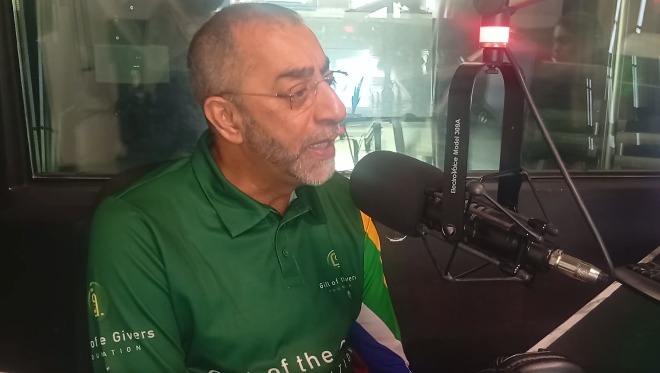
“The Border Management Authority (BMA) acted in keeping with their mandate not to allow passengers without an exit stamp to disembark. Israel deliberately did not stamp the passports of these poor people to exacerbate their suffering in a foreign country,” said Dr Imtiaz Sooliman founder of GOTG.
Sooliman added that the Department of Home Affairs has significantly delayed the process, although other authorities have been supportive in trying to expedite refugee status for the Palestinian asylum seekers.
The BMA confirmed that the 153 Palestinians who arrived in South Africa are eligible for 90-day visa-exempt travel. The group was held at OR Tambo International Airport for 12 hours after initially being denied entry due to missing departure stamps in their passports. They were allowed to disembark following a commitment from Gift of the Givers to provide accommodation.
Department of Home Affairs’ update
Minister of Home Affairs Dr Leon Schreiber provided details on the processing of the travellers at OR Tambo International Airport.
“Yesterday, a chartered flight arrived in Johannesburg from Nairobi, Kenya. Upon arrival, the 153 travellers on board were facilitated through immigration processes by BMA officials. During the process, officials noticed the absence of departure stamps in some passports, and that some travellers did not appear to have return tickets or addresses for accommodation in South Africa,” explained Schreiber.
He noted that holders of ordinary Palestinian passports enjoy 90-day visa-exempt access to South Africa, subject to security and verification procedures.
“As a result of the discrepancies in this case, the BMA could not allow immediate entry, as further verifications were required. The Government of South Africa subsequently engaged with the Palestinian embassy and other stakeholders. It was established that the absence of stamps, return tickets, and accommodation addresses did not indicate an intention to apply for asylum,” he said.
Civil society groups respond
Naeem Jeena, a passenger on the flight and representative of a collective of civil society organisations, questioned the legality of keeping the travellers on the plane for 12 hours.
“Our legal team is assessing whether it is legal to keep passengers on a plane for that duration. While we are unsure, our suspicion is that it is not legal, but this is still under review,” said Jeena.
He denied claims by the Department of Home Affairs, stating that the Palestinians did not request asylum.
The Cape Town Ulama Board’s stance
The Cape Town Ulama Board commended the decisive and compassionate action taken by South African authorities and civil society organisations in trying to grant refuge to the stranded Palestinians.
The Embassy of the State of Palestine in South Africa
The embassy confirmed it has been working closely with South African authorities to resolve the humanitarian situation.
“The Embassy highly appreciates the sovereign and humane decision of the Government of South Africa to grant 90-day entry visas to the Palestinian passengers. This reflects South Africa’s long-standing principled support for the Palestinian people,” the embassy said.
It also clarified that the travel of these 153 Palestinians was arranged by an unregistered organisation that exploited the humanitarian situation in Gaza, deceived families, collected money from them, and facilitated travel in an irregular and irresponsible manner.
“This entity later attempted to disown responsibility once complications arose,” the embassy added.
This is a developing story. VOC News will provide updates as more information becomes available.
Photo: VOCfm