
UN climate talks are heading towards a rocky conclusion after two weeks of fraught debate failed to resolve several key disputes, as the UN chief called on world leaders to speed up and agree on a deal to prevent “climate catastrophe”.
“There is still a lot more work to be done. The world is watching us,” Alok Sharma, Britain’s president of the COP26 summit, told reporters on Thursday about the state of negotiations in the Scottish city of Glasgow.
The COP26 conference set out with a core aim: to keep alive the 2015 Paris Agreement’s aspirational target to cap global warming at 1.5 degrees Celsius (2.7 Fahrenheit) above pre-industrial levels and avoid the worst effects of climate change.
But under countries’ current pledges to cut emissions this decade, researchers say the world would hit levels of global warming far beyond that limit, unleashing catastrophic sea level rises, floods and droughts.
While there is little hope that new promises will appear on Friday, the final day of talks to bridge that gap, as negotiators are attempting to impose new requirements that could force countries to hike their pledges in future, hopefully fast enough to keep the 1.5C goal within reach.
Scale up climate goals
A draft of the COP26 deal which circulated earlier this week, for example, would force countries to scale up their climate goals by next year, three years sooner than planned. It also urged countries to speed up their decarbonisation plans. At the moment, countries are required to revisit their pledges every five years.
With one day left of scheduled talks, the nearly 200 participating countries are hardly any closer to an agreement over whether national emissions-cutting plans must be ramped up in the short term, how climate action is reported, and how vulnerable nations are supported.
A new draft document published on Friday morning appeared to weaken the language around the phasing out of fossil fuels to try to reach agreement between the nearly 200 nations present in Glasgow.
The draft had baldly stated that the world should pledge to stop subsidies for fossil fuels and phase them out. Now the text includes the word “unabated” before coal, and the phase-out of “inefficient” subsidies for fossil fuels.
The paragraph now reads: “(COP26) calls upon Parties to accelerate the development, deployment and dissemination of technologies and the adoption of policies for the transition towards low-emission energy systems, including by rapidly scaling up clean power generation and accelerating the phase-out of unabated coal power and of inefficient subsidies for fossil fuels.”
European Union climate policy chief Frans Timmermans had said on Thursday that removing that language “would be an extremely, extremely bad signal”.
Al Jazeera’s Andrew Simmons said the draft’s wording had changed because of “strong opposition from fossil fuel states including Saudi Arabia and China.”
“It doesn’t necessarily mean that fossil fuels will be phased out because a potential get-out clause is there,” Simmons added.
UN Secretary-General Antonio Guterres said on Thursday that countries’ climate plans were “hollow” without commitments to rapidly phase out fossil fuels.
“Governments need to pick up the pace and show the necessary ambition on mitigation, adaptation and finance in a balanced way. We cannot settle for the lowest common denominator. We know what must be done.”
Negotiations received a shot in the arm on Wednesday when the United States and China – the two largest emitters – unveiled a joint climate action plan.
Although it was light on detail, observers said the pact allayed concerns that frosty US-China relations entering into COP26 would derail the talks.
Developed vs developing countries
Questions of finance continue to loom over the talks, with developing countries pushing for tougher rules to ensure that rich countries, whose historical emissions are largely responsible for heating up the planet, offer more cash to help the poorest nations adapt to climate impacts.
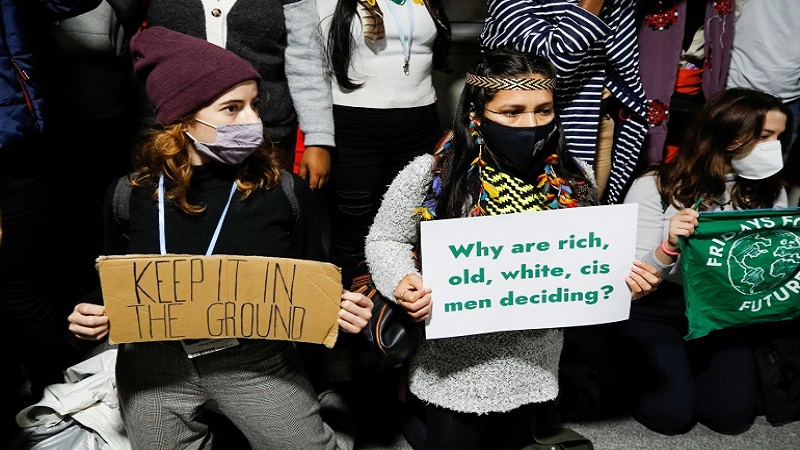
COP26Climate activists protest during the UN Climate Change Conference (COP26) in Glasgow [Phil Noble/Reuters]
Trust levels between rich polluters and developing nations are low after developed countries failed to stump up the $100bn a year they promised by 2020.
Developed nations meanwhile, favour a greater push on emissions reductions, a goal countries yet to fully electrify their grids – and largely blameless for emissions – feel is unfair.
“We have made steps forward,” European Commission vice president Frans Timmermans told the AFP news agency.
“It’s not enough to address the issue that we face, but we’re having a completely different conversation now than we had only a couple of months ago. Adaptation has really gone up on our global agenda.”
Countries already battered by climate disasters such as record-breaking drought and flooding are demanding they be compensated separately for “loss and damage”.
Organisers said the draft texts dedicated an “unprecedented” section to loss and damage, but vulnerable nations said it stopped far short of their expectations.
Eduardo Mansur, director of the office of climate change at the UN’s Food and Agriculture Organisation, told Al Jazeera that discussions on farming and adaptation were falling short of expectations.
“Adaptation didn’t receive the attention and the funding that it deserves,” Simmons said, adding that agriculture and food systems represent around one third of global emissions.
“We have three times more carbon in the soil than we have in the atmosphere and we know that good soil management can increase the sequestration potential of the soil,” Simmens said. “We have to invest on that and bring incentives to farmers.”
Tracy Carty, head of Oxfam’s COP26 delegation, said the draft text was still missing some vital elements.
“Most glaring is the lack of any mention of the finance plan for loss and damage that was proposed last night by the G77 group of developing countries,” Carty said in a statement. “Rich countries must stop blocking progress and commit to doing something about it.”
Other issues likely to delay an agreement in Glasgow include a long-simmering dispute over the rules governing carbon markets and standardised reporting timeframes.
A final deal will require the unanimous consent of the nearly 200 countries that signed the 2015 Paris Agreement.
Source: Al Jazeera