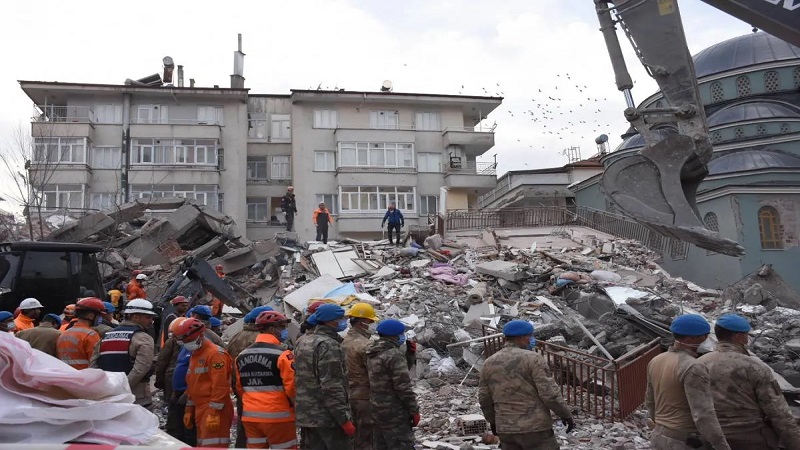
The two major earthquakes which hit Turkiye on 6 February caused about $34.2 billion in direct physical damage, but total reconstruction and recovery costs facing the country could be twice as high, the World Bank said on Monday, Reuters reports.
The Bank estimates that the earthquakes would also shave at least half a percentage point off Turkiye’s forecast gross domestic product growth of 3.5 per cent to 4 per cent in 2023, Humberto Lopez, World Bank Country Director for Turkiye, told reporters.
The situation in Syria, which was also affected by the quakes, was “really catastrophic”, said Anna Bjerde, World Bank Group Vice President for Europe and Central Asia. The Bank will release a separate damage estimate for Syria on Tuesday.
Bjerde said the initial rapid damage assessment for Turkiye of $34.2 billion was equivalent to about 4 per cent of its economic output in 2021, but that did not include indirect or secondary impacts on the growth of its economy, or the most recent earthquake a week ago.
“Our experience is that reconstruction needs can run as high as two to three times the estimated direct physical damage,” she said.
The 6 February earthquakes of 7.8 magnitude and 7.5 magnitudes, the most deadly in modern Turkiye’s history, killed more than 44,300 people.
The World Bank said the earthquakes had been followed by more than 7,500 aftershocks, creating the largest such disaster to strike Turkiye in over 80 years.
The Bank’s Global Rapid Post-Disaster Damage Estimation (GRADE) report estimates that 1.25 million people were made homeless by damage to their homes, or their complete collapse.
The heaviest damage occurred in 11 provinces in southern Turkiye that have some of the country’s highest poverty rates, and host more than 1.7 million Syrian refugees, or about half the total Syrian refugee population in Turkiye, the report found.
The World Bank has provided immediate assistance of $780 million for Turkiye from two existing projects in Turkiye, as well as $1 billion in a new emergency recovery project.
Source: Middle East Monitor