by Tauhierah Salie
Stakeholders in the Western Cape are proactively tackling concerns over a drop in South African students taking up Mathematics and Science subjects. Students have reportedly been opting for the so-called ‘less intimidating’ subjects at a more frequent rate.
A collaboration between Non-Profit Company Advancing Knowledge, Garden Cities Archway Foundation and the Western Cape Education Department has opened several new ‘science centres’ across the province.
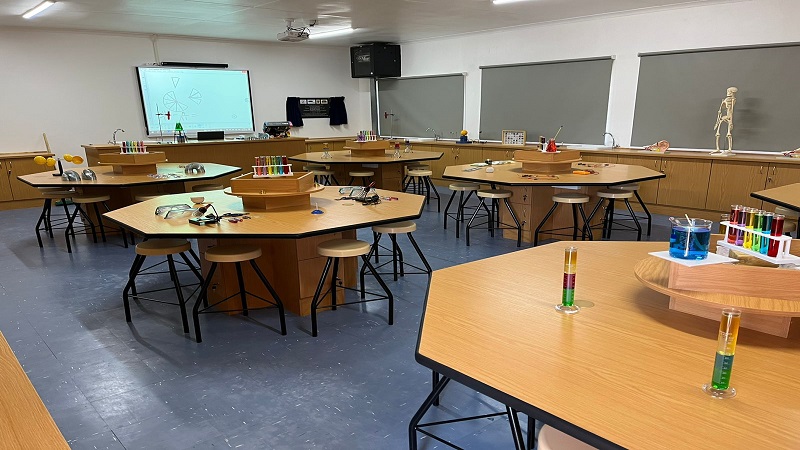
The science laboratories have been transformed into modern Science Teaching & Learning Centres, which “serve as creative spaces to teach (Science, Technology, Engineering and Mathematics) or STEM subjects”.
Speaking to VOC, Director of AK NPC, Prof Shaheed Hartley described the centers as the incubators of a culture of science teaching and learning.
Hartley said the provision of accredited support courses seeks to help teachers to teach more effectively. An event titled “Women in Mathematics”- being held at the Capetonian Hotel on the 24 August 22- is meanwhile an example of sparking interest in the fields.
“(We) show them how to teach science with elementary stuff but still teaching the same concepts, principals’ laws, and theories (and) build the culture of science teaching. On the other side, we want to get students more involved in science activities like science clubs,” he said.
Prof Hartley admitted that there is a concern of schools phasing out maths and science. According to prof Hartley, getting the ‘basics instilled aids the long-term success of students, regardless of the field they choose. The stigmatization of the ‘harder’ subjects, he said, equally needs to be addressed.
“The stigma is real. If you go to the schools, you will hear learners talking about ‘tough’ subjects and we need to move away from that. The only way we can do that is provide opportunities for learners to learn science practically- hands on- so that they can develop the investigative skills to understand the content of the science curriculum,” the professor elaborated.
Country Manager at global mentorship company, Crimson Education, Rebecca Pretorius, told VOC that schools have cited various reasons including a deficit of teachers, the impact of the Covid-19 pandemic and students not having sufficient time in class. Pretorius said however that students are not at fault. She similarly encouraged getting students excited about pursuing these pathways.
“I don’t think the learners are to blame because they simply don’t want to do the subjects; I think schools are too quick to push students away from the tough subjects, often drawing the line at having them get 50 percent for maths or otherwise having to switch to maths literacy. Perhaps, (they’re) not focused enough on building students’ maths and science confidence and skills,” said Pretorius.
Prof Hartley emphasized the importance of critical thinking to carry the country forward, warning that a lack thereof will result in having to import these skills as opposed to harvesting them from our own.
“If we don’t create the spaces that learners can learn in a hands-on manner, then we face (these) challenges. The more things are changing, the more important it is to get our students to take these subjects and take the fear element out of it,” said Hartley.
“The future that we’re looking at, the kind of careers that are coming out of the fourth and fifth industrial revolution, are things we have not even seen. If we don’t inculcate that critical thinking (and) inquiring-based skills, we are facing a major challenge.”
According to Pretorius, despite the high youth unemployment, graduate employment rate is relatively low compared to other educational levels. (Most) employers are looking for someone who has a degree or a diploma. It doesn’t necessarily reduce the value of other sectors like entrepreneurship, but it does mean that students will struggle to find a job without a tertiary education.
Hartley said it’s important that the lack of interest be reversed, given that a lack of science and mathematics skills would leave unavoidable problems without solutions.
“At no other time, have we had the importance of science and mathematics during this pandemic. The people who are collecting and analyzing data with regard to Covid-19 (and) interpreting and drawing conclusions from that data, are people that need science and mathematics. Those are the people, in those careers, that will then make informed decisions,” said the Professor.
“It certainly will have an impact on students. South Africa will also be less competitive globally. More importantly, we won’t have the skills and resources we need to solve the problems we have that come from not having top engineers, scientists and economists,” Pretorius echoed.
On advice to solve the problem, Pretorius emphasized the need to secure literacy competence. She spoke to unfulfilled resolutions from an in-depth study by University of Pretoria on reading literacy, where the first step is to acknowledge that there is a crisis:
“… (things) That will help raise literacy levels without actually thinking about having to have very complex solutions. Resource schools with books, posters and so on. More reading time at home. More parents reading to children. More time on tasks. Better standards. Developing writing competition, literacy dives. Really just promoting literacy,” she said.
“Try to apply yourself – do not move away from the subjects. There are many tutorial programs out there. Show interest. Ask people to assist. Ask the teacher to explain to you, your peers who understand a little better than you do. Parents: please support your children. It’s important for their future so we can at least give them the basic foundation from where they can make informed decisions,” urged Prof Hartley.
On Thursday, 21 July, three Science TLC facilities were opened at Norma Road Primary, Silvertown (Athlone), Sokhanyo Primary, (Gugulethu) and Westbank No.1 Primary, Diepwater, (Blue Downs). De Heide Primary in Bredasdorp, Emil Weder Secondary in Genadendal, De Rust Futura Secondary and Groenberg Secondary in Grabouw, also received upgrades on Monday.
The latest additions bring the number of Science TLCs constructed at Western Cape schools to a total of 87, since 2011.
VOC